
Abu Dhabi Peace Talks: Russia, Ukraine and US Meet Again for the First Time Since February
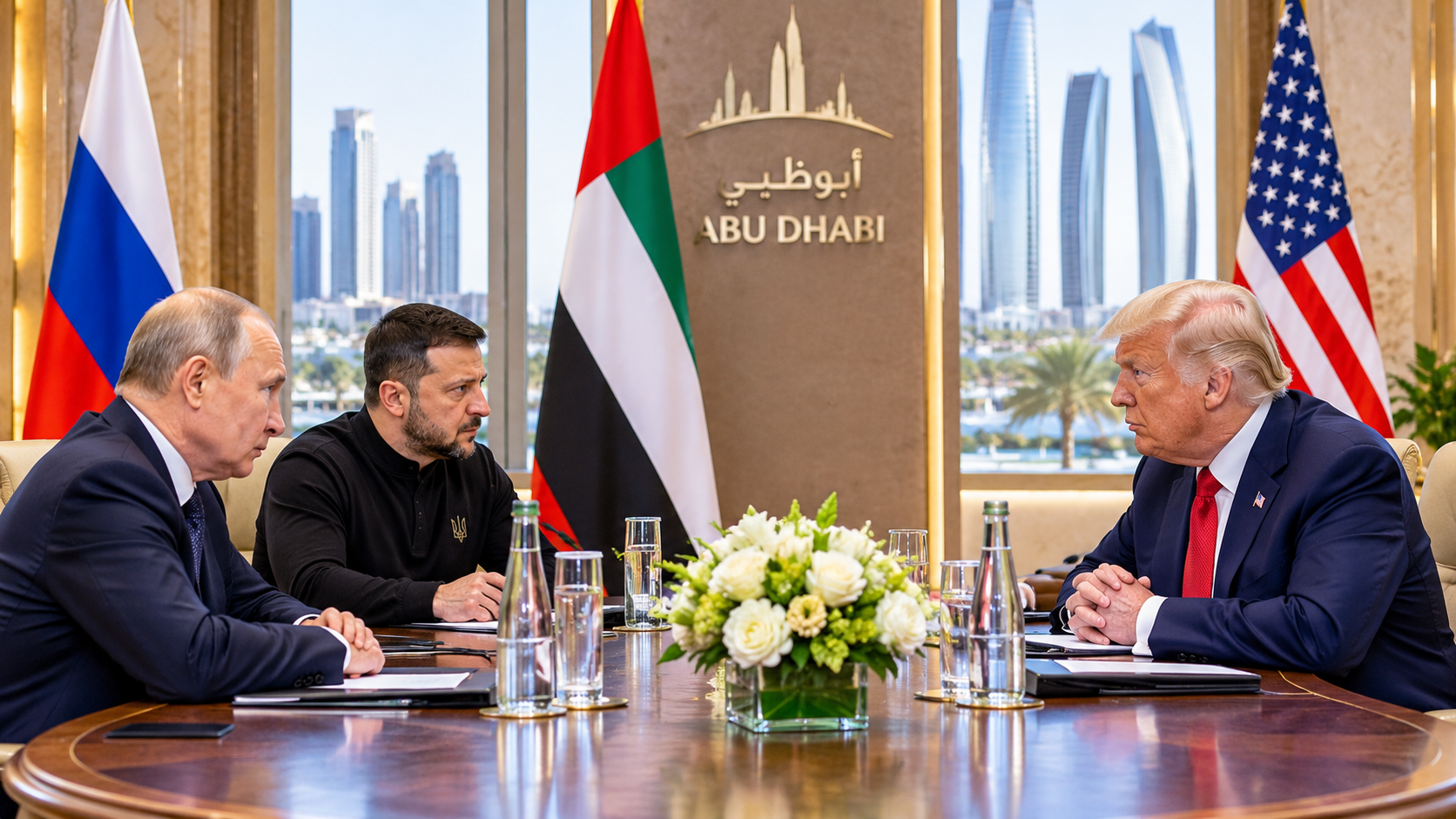
Delegations from Russia, Ukraine and the United States opened a two-day round of talks in Abu Dhabi on Tuesday, the first trilateral meeting since February. The opening session lasted nearly four hours and talks resume on Wednesday. Expectations of a breakthrough remain low.
Negotiators from Russia, Ukraine and the United States gathered in Abu Dhabi on Tuesday for the first three-way peace talks since February, starting a two-day round that few expect to end the war but that many regard as a necessary restart after months of stalemate.
The opening session ran for almost four hours, Ukrainian officials said, and discussions are due to continue on Wednesday. Jared Kushner, who is helping lead the American effort alongside envoy Steve Witkoff, told reporters he had heard some good ideas for narrowing the differences between the sides.
Who is at the table
Ukraine's delegation is headed by Rustem Umerov, the country's foreign intelligence chief and chief negotiator. He is joined by Kyrylo Budanov, head of President Volodymyr Zelensky's office, along with deputy office head Serhii Kyslytsia, parliamentary leader David Arakhamia and Vadym Skibitsky from military intelligence.
Russia sent presidential aide Vladimir Medinsky, who took part in earlier rounds in 2022 and 2025, together with deputy foreign ministers Sergei Ryabkov and Mikhail Galuzin, military intelligence chief Igor Kostyukov and a senior General Staff officer, Yury Zhigarlovsky. Washington is represented by Witkoff and Kushner, both of whom have travelled to Kyiv and Moscow since the last formal talks.
European officials are in the city too, though outside the trilateral format. National security advisers from France, Germany, the United Kingdom and Italy, plus representatives of NATO and the European Union, are coordinating with the Ukrainian and American sides. Umerov said his team met them on Tuesday.
What is on the agenda
Umerov described the agenda as covering the central questions of ending hostilities and moving closer to peace. Kyiv has signalled it wants to use the technical-level discussions to press for more prisoner exchanges and to explore a possible ceasefire covering energy infrastructure and shipping at sea. It also hopes to lay the groundwork for a meeting of leaders.
American officials have said the sessions could open the door to wider conversations about security arrangements in Europe and about postwar security concerns on both the Ukrainian and Russian sides. The White House has said the talks centre on future security guarantees.
Positions remain far apart
The gaps are large. According to the Associated Press, Russian President Vladimir Putin has demanded that Ukraine withdraw from four regions Moscow claims to have annexed, abandon its bid to join NATO and accept limits on the size of its armed forces. Reporting from Kyiv adds that Moscow's demands have centred on the Donbas region in the east.
Zelensky has rejected those terms and wants a ceasefire first, with broader negotiations to follow. He has also argued that any settlement must include credible security guarantees, including continued Western military support, a European-led reassurance force and commitments modelled on NATO's collective defence clause. US Secretary of State Marco Rubio has said that guarantees for Ukraine also need to be acceptable to Russia, a point Kyiv is unlikely to welcome.
Kushner said a lasting deal would eventually require direct talks between Russia and its European neighbours on regional security. In a statement he said any future arrangement must respect Ukraine's sovereignty and territorial integrity and offer credible guarantees.
Fighting continues as talks begin
There was no pause on the battlefield. Ukraine's air force said Russia launched 162 drones and a ballistic missile overnight, while Russia's Defence Ministry said its forces shot down 155 Ukrainian drones over eight Russian regions and Crimea. With winter approaching, Moscow has stepped up attacks on Ukraine's energy grid.
A narrow humanitarian ceasefire in the Russian-occupied city of Oleshky, brokered with help from US First Lady Melania Trump, allowed aid and civilian evacuations in recent days. It did not extend beyond that area.
Expectations are muted
The past year offers little reason for optimism. The Associated Press notes that three earlier rounds of talks this year produced no breakthrough, and German Chancellor Friedrich Merz said on Monday that he had no high hopes for this one. Arakhamia, speaking to Deutsche Welle before the meeting, said he did not expect a breakthrough in the first round but was more hopeful about the second, and added that simply resuming contact after such a long pause counts as progress.
President Donald Trump has kept up public pressure for a deal. In a CBS interview aired on 8 November he said he believed the war would end soon and that Ukraine would emerge in a somewhat different shape. On 5 November he said he had met Russian envoy Kirill Dmitriev and spoke of a big agreement involving Ukraine, Russia and Europe, though no details were made public.
Why Abu Dhabi
The UAE has positioned itself as a neutral venue for sensitive diplomacy, and hosting the delegations puts the capital at the centre of one of the world's most closely watched negotiations. The timing is notable: the Gulf is itself under pressure from the Iran war, with attacks on shipping and missile threats in the region.
What happens next
The second day of talks is expected to show whether Tuesday's long session produced anything concrete, such as agreement on prisoner exchanges or a framework for a limited ceasefire. If it does, the process could build towards a leaders' meeting. If not, the talks risk joining the list of rounds that ended without result.
Leave a comment
Your email address will not be published. Required fields are marked *