ADNOC Cuts Murban Premium for December as Gulf Producers Fight for Asian Market Share
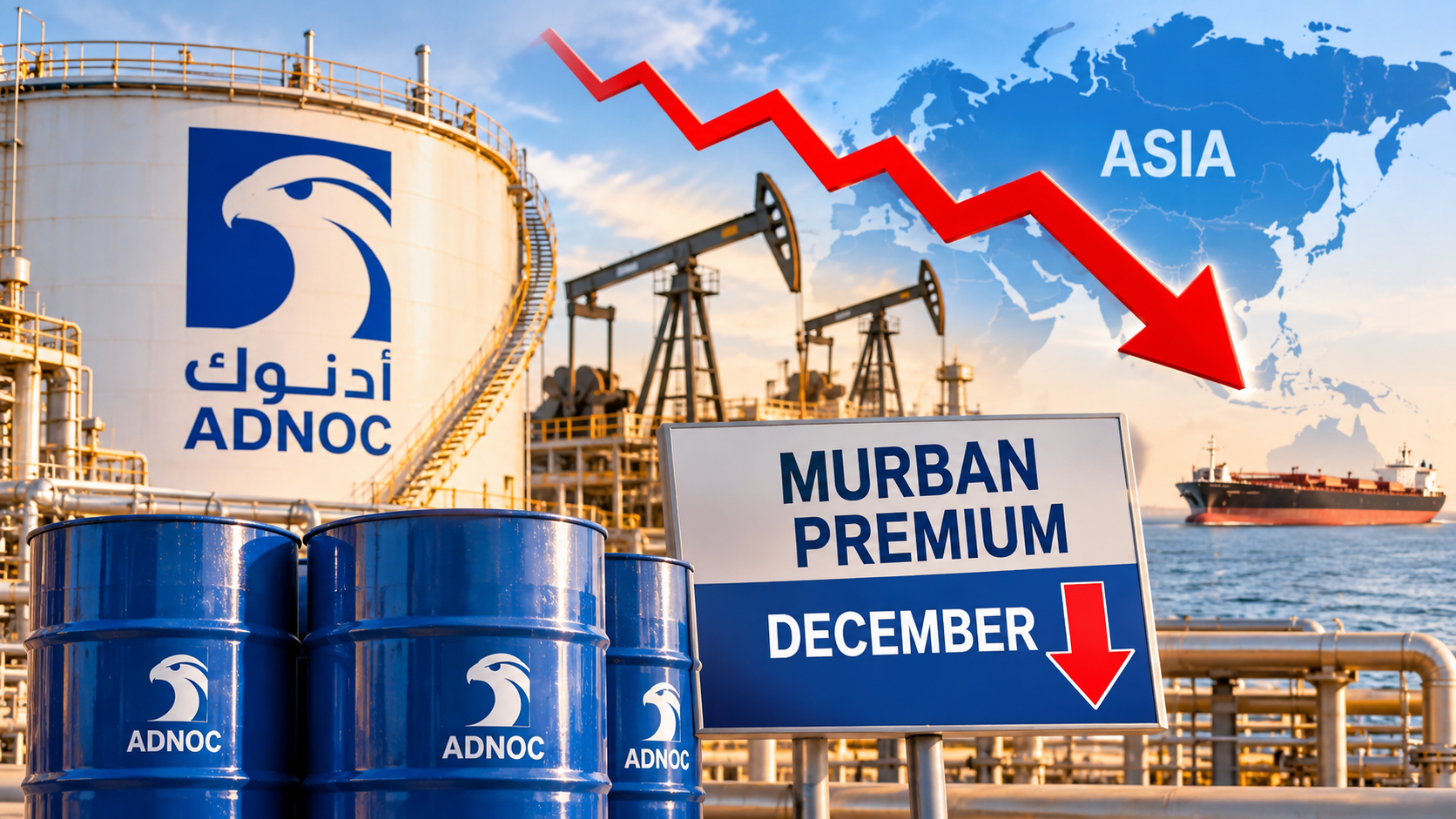
ADNOC has reportedly cut the December premium on its flagship Murban crude by more than 60 per cent to $4 a barrel, shortly after Saudi Aramco's own price cuts. The moves reflect a rebound in Gulf exports and growing competition for buyers in Asia.
Abu Dhabi's national oil company has sharply lowered the price premium on its flagship crude, a sign that the contest for Asian customers is heating up as Middle East supply returns to the market.
According to Bloomberg, which cited traders familiar with the release, ADNOC cut the premium for its December-loading Murban grade by more than 60 per cent to $4 a barrel. The figure is set as a differential to the Dubai benchmark. The report said official selling prices for the UAE's other main grades were also trimmed from November. The arithmetic implies the previous premium was above $10 a barrel.
Following Saudi Arabia's lead
The reduction came shortly after Saudi Aramco lowered its own prices. Reuters reported on 6 November that Aramco cut the December price of Arab Light for Asian buyers by $2 a barrel, setting a discount of $6.50 against the Oman/Dubai average. That is the weakest level since May 2020, during the pandemic. Prices for northwest Europe and the Mediterranean were reduced by $1, while US prices were left unchanged.
The Saudi move went further than many in the market had predicted. A Reuters survey the week before suggested refiners expected Aramco to hold prices flat or cut by up to $2. Iraq's state marketer SOMO followed, widening discounts on its Basrah Medium and Basrah Heavy grades for Asia to $8.80 and $11.80 a barrel respectively, according to Oil & Gas Middle East.
Why prices are under pressure
The common thread is supply. Spot premiums for Middle Eastern crude have fallen back to levels last seen before the war with Iran began, as producers pushed out more barrels even though attacks on tankers near the Strait of Hormuz continue. Refining margins in Asia have also cooled, which has dampened appetite from buyers.
Data from the analytics firm Kpler, cited by Modern Diplomacy, shows crude exports through the strait averaged 10.3 million barrels a day in October. That compares with close to zero in the first month of the conflict, excluding Iranian shipments, and with roughly 13.5 million barrels a day before the war. Counting alternative routes such as Saudi Arabia's Red Sea port of Yanbu and the UAE's Fujairah terminal, combined regional exports reached 16.6 million barrels a day, against a pre-war average of about 17 million.
HSBC has lifted its forecast for Saudi fourth-quarter crude production to 8.3 million barrels a day from 6.3 million, saying exports have recovered faster than it had expected.
What a premium cut means
Producers in the Gulf typically sell under term contracts to refiners, with the price expressed as a premium or discount to a regional benchmark. Lowering the premium makes the crude cheaper relative to rival grades, a straightforward way to win or keep customers. For Murban, a light, sweet grade popular with Asian refiners, a lower differential is likely to make December cargoes more attractive against Saudi and other competing supplies.
The sharp size of ADNOC's reduction suggests the company does not want to cede ground to Riyadh, particularly while buyers weigh up shipping risks and insurance costs. It is a competitive decision as much as a reflection of market conditions.
Security risks have not gone away
The pricing news arrives on a day when the risks around Gulf energy shipping were again on display. ADNOC Logistics & Services confirmed that one of its vessels was damaged in an attack in UAE territorial waters. Shipping through Hormuz still runs far below pre-war levels, according to UKMTO data reported by Gulf News, and tankers continue to be targeted.
Those conditions help explain why sellers are adjusting prices even as their volumes recover. Higher freight and war-risk costs fall on buyers, so producers have an incentive to offset part of that burden by trimming their own premiums.
Peace could add to the pressure
Analysts have begun to ask what a lasting settlement would do to the market. A durable agreement would make shipping through Hormuz more predictable, lower transport costs and allow Gulf producers to raise output further. In a market already seeing rising supply, that could tip the balance towards a glut and a more aggressive price war. President Donald Trump has said renewed military action against Iran appears unlikely, and talks involving Qatar and other mediators are continuing, but no deal has been reached.
What it means for the UAE
For the UAE, the immediate effect is limited to the premium it charges buyers, not the headline price of crude, which is driven by global benchmarks. But the direction matters. Lower premiums reduce revenue per barrel, while higher volumes from Fujairah and elsewhere can offset some of that. ADNOC has been in a position of relative strength, with the UAE's alternative export route outside Hormuz, but it is not immune to a more crowded market.
The next signals to watch are Saudi Aramco's January pricing, ADNOC's cargo volumes for December and whether other regional producers follow the same path.
Leave a comment
Your email address will not be published. Required fields are marked *