
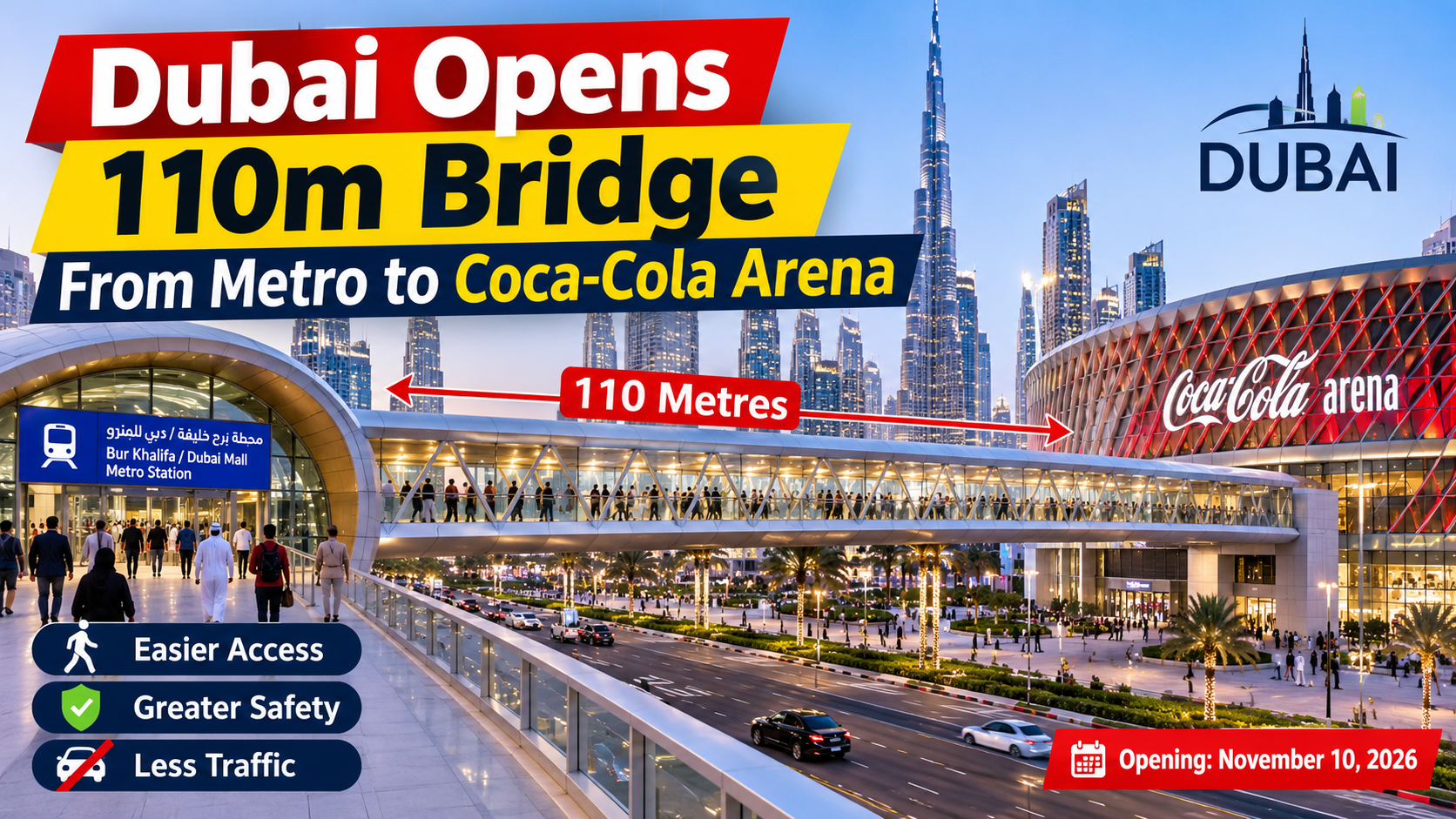
Dubai Opens 110-Metre Bridge Linking Metro Station to Coca-Cola Arena
Dubai's RTA and Meraas are opening a 110-metre pedestrian bridge on 10 November that connects the Burj Khalifa/Dubai Mall Metro Station with Coca-Cola Arena at City Walk. The RTA says it can carry about 10,000 people an hour and forms part of a wider pedestrian safety programme.
Anyone taking the Metro to a concert or match at City Walk gets a simpler route from Tuesday. Dubai's Roads and Transport Authority (RTA) and Meraas, a member of Dubai Holding Real Estate, are opening a 110-metre pedestrian bridge that joins the Burj Khalifa/Dubai Mall Metro Station directly to Coca-Cola Arena.
A direct link for event crowds
The new bridge is meant to move large groups on foot from the station to the arena without sending them across busy roads at street level. The RTA says it can handle roughly 10,000 people an hour, a figure that counts for a lot on nights when a full house leaves the venue at the same moment.
Coca-Cola Arena opened in 2019 and is operated by Legends Global under the ownership of Dubai Holding. It can hold 17,000 people and stages live music, sport and other events all year. Until now, visitors arriving by train have had to pick their way through the roads around City Walk, often at precisely the hour when traffic in that part of the city is heaviest. The bridge gives them a dedicated, direct path instead.
Part of a wider push on pedestrian safety
The opening belongs to a package of traffic and infrastructure improvements the RTA is delivering together with Dubai Holding. The stated aims are better links between key districts and tourist and entertainment destinations, easier movement for residents and visitors, and safer streets.
The figures behind that push are striking. According to the RTA, the number of pedestrian bridges and tunnels in Dubai grew from 26 in 2006 to 178 by the end of 2025. Over the same stretch of years, the pedestrian fatality rate fell from 9.5 deaths per 100,000 people.
The authority is not slowing down. Its five-year plan for 2026 to 2030 calls for 31 more pedestrian bridges and tunnels across the emirate, which suggests that walkways of this kind will keep appearing in the city's busiest corridors.
Why this stretch needed a crossing
City Walk has grown into one of Dubai's busiest leisure districts, and the gap between the Metro line and the arena has long been a point where foot traffic and vehicles compete for space. The RTA had earlier named a crossing near Coca-Cola Arena among a batch of new bridges planned for the area, alongside others in Business Bay and close to the Burj Khalifa district.
It follows work already completed elsewhere. In September 2025, the authority finished two pedestrian bridges, on Sheikh Rashid Street and Al Mina Street, as part of its corridor improvements in the older parts of the city. At the time, the RTA reported that pedestrian satisfaction in Dubai stood at 88 per cent and that pedestrian trips had risen from 307 million in 2023 to 326 million in 2024, a gain of about 6 per cent.
Those numbers point to a city where walking is no longer an afterthought. Dubai's planners have spent years encouraging residents to use the Metro for the first and last stages of a journey, and every safe, shaded or covered link between a station and a destination makes that habit easier to keep.
What visitors should keep in mind
For anyone heading to an event at the arena this week, the practical advice is simple. The Metro remains the quickest way to reach City Walk when roads are congested, and the new bridge shortens the final stretch. Even so, station platforms and approach routes will stay crowded after big shows, so it is wise to allow extra time, particularly on weekend evenings.
Event organisers and nearby businesses are also likely to feel the effects. A smoother flow of visitors from the station should reduce pressure on drop-off points and taxi queues around the venue, a recurring complaint after large concerts.
Residents who live near City Walk may notice a quieter evening commute as fewer pedestrians cut across traffic. The RTA has not published a full list of operating details beyond the opening, so those planning to use the bridge for the first time should check the authority's official channels for any updates.
The bigger picture
Dubai's transport planners often describe road safety and public transport as two halves of one strategy: make it safer to walk to a station, and more people will leave the car at home. The Coca-Cola Arena bridge is a compact example of that thinking. It costs drivers nothing, protects pedestrians, and ties one of the city's largest entertainment venues more tightly to the Metro network.
With 31 further bridges and tunnels on the 2026–2030 list, this opening is unlikely to be the last of its kind in Dubai's most visited districts.
Leave a comment
Your email address will not be published. Required fields are marked *