
UAE Formally Joins Pacific Islands Forum as Strategic Partner, Opening New Trade and Climate Ties
The UAE has been formally recognised as a Strategic Partner of the Pacific Islands Forum, joining twelve other major global powers including the US, China and the EU. The status, confirmed at the Forum's Leaders' Meeting in Palau, is expected to open new opportunities for trade, investment and cooperation on climate resilience with Pacific Island nations.
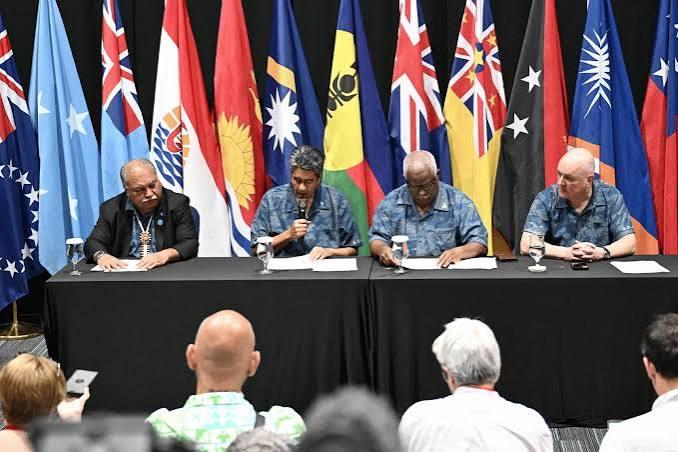
The United Arab Emirates has been formally recognised as a Strategic Partner of the Pacific Islands Forum, marking a significant expansion of the country's diplomatic and economic footprint in a region thousands of kilometres from its own shores. The decision, confirmed at the Forum's Leaders' Retreat held as part of the 55th Pacific Islands Forum Leaders' Meeting in Koror, Palau, places the UAE alongside twelve other Strategic Partners, including China, the United States, France, Germany, the United Kingdom, Canada, Japan, India, Indonesia, Singapore, South Korea and the European Union.
The announcement followed the participation of Noura bint Mohamed Al Kaabi, the UAE's Minister of State, who represented President Sheikh Mohamed bin Zayed Al Nahyan at the Forum's Leaders' Meeting, held over several days in Koror. The elevation to Strategic Partner status is being framed by UAE officials as the culmination of years of quieter engagement with Pacific Island nations, rather than a sudden diplomatic pivot, with cooperation already established in areas such as renewable energy, climate resilience, education and broader sustainable development initiatives across Small Island Developing States.
For the Pacific Islands Forum, an organisation representing island nations that are often on the front lines of climate change impacts such as rising sea levels and extreme weather, adding a well-resourced Gulf partner like the UAE carries practical significance. Strategic Partner status is expected to create a more structured platform for engagement between the UAE and PIF member states, opening pathways for expanded trade relationships, new investment flows and deeper business partnerships. It is also expected to support knowledge exchange in several forward-looking sectors, including the broader energy transition, digital transformation, regional connectivity and climate resilience planning.
Speaking on the milestone, Al Kaabi described the recognition as building on years of close cooperation with Pacific nations, grounded in mutual respect and a shared commitment to sustainable development. She characterised the new chapter in the relationship as holding particular significance for the UAE, framing it as a reflection of the strength of ties the country has steadily built across the wider Pacific region over time. Separately, Omar Shehadeh, the UAE's envoy of the Minister of Foreign Affairs to the Caribbean and Pacific States, noted that the new status creates fresh avenues for collaboration with Pacific nations, reinforcing connectivity and shared goals between the two regions.
The move builds on groundwork laid earlier in the same Forum cycle. In the days leading up to the Strategic Partner announcement, Al Kaabi took part in the Leaders' Ascent Dialogue on Climate-Smart Investment, a session chaired by the Forum and held as part of broader regional preparations ahead of the Pre-COP31 discussions planned for Fiji and Tuvalu, and the COP31 summit itself, which is set to take place in Antalya, Turkiye. That dialogue brought together Forum partners to advance thinking around climate-smart investment, with a particular emphasis on renewable energy and building climate resilience across vulnerable island economies.
Pacific Islands Forum leaders reportedly welcomed the UAE's expanding partnership with the region during the discussions, commending the country's contributions to renewable energy deployment, digitisation efforts and capacity-building work tied to climate resilience. Leaders also pointed to the legacy of COP28, hosted by the UAE in 2023, including the so-called UAE Consensus reached by 198 parties at that summit, as evidence of the country's continued, practical, investment-driven approach to climate action on the international stage.
For the UAE, the Strategic Partner designation represents another step in a broader pattern of diplomatic outreach that has seen the country deepen ties with regions well beyond its traditional Gulf and Middle East sphere of influence in recent years. By formally aligning itself with established global powers already holding Strategic Partner status within the Forum, the UAE positions itself to participate more directly in shaping regional priorities across the Pacific, rather than engaging purely through bilateral channels on a country-by-country basis.
Looking ahead, officials on both sides have signalled an intention to deepen the partnership in the years to come, with trade, investment and climate cooperation likely to serve as the primary pillars of the relationship. As COP31 preparations continue and Pacific nations look for partners capable of supporting large-scale climate resilience projects, the UAE's newly formalised role within the Forum is expected to translate into concrete initiatives over the coming months, building on the diplomatic foundation laid in Koror.
Leave a comment
Your email address will not be published. Required fields are marked *