
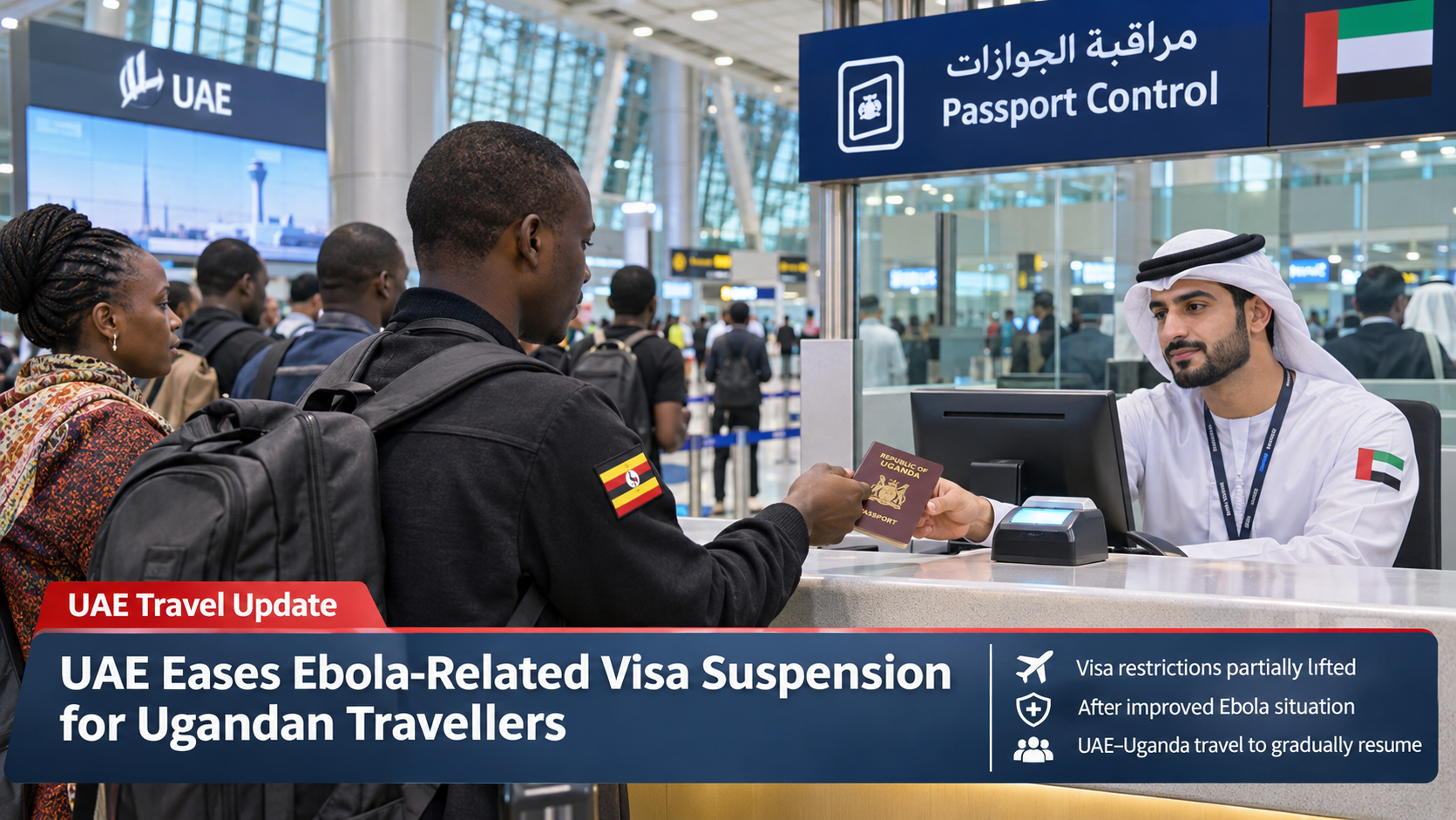
UAE Lifts Ebola-Related Visa Suspension for Ugandans, Keeps Curbs on DRC and South Sudan
Ugandan passport holders can again receive UAE visas if they left their country at least 21 days before arrival. Suspensions remain for travellers from the Democratic Republic of the Congo and South Sudan.
The UAE has lifted its suspension on new visas for Ugandan passport holders, easing one of the travel restrictions introduced as a public-health precaution linked to Ebola concerns. The decision, announced on Wednesday, comes with a condition and does not extend to every country covered by the measures.
What has changed
Under the revised rules, Ugandan passport holders can enter the Emirates provided at least 21 days have passed since they left Uganda. In practical terms, that means a traveller who has spent three weeks or more outside Uganda before arriving in the UAE will no longer be barred on the basis of nationality alone.
Visa suspensions remain in place for travellers from the Democratic Republic of the Congo and South Sudan, with authorities citing ongoing health concerns. Those measures continue to apply.
Who is exempt
The rules include several exemptions. Ugandan students who were enrolled in UAE institutions before June 2026 are exempt from the restrictions, as are embassy administrative staff and holders of diplomatic passports.
Humanitarian and medical cases will be assessed individually. Travellers in those categories will be required to present approved medical reports detailing their diagnosis and treatment plans.
The official rationale
In its statement, the UAE said the measures reflect the country's commitment to protecting public health, strengthening preparedness and responding to health risks. That language is consistent with how governments in the region have approached outbreak-related travel controls: as temporary, risk-based tools that are adjusted as the situation evolves, rather than permanent bans.
Why 21 days
The 21-day condition is not arbitrary. Health authorities generally treat 21 days as the outer limit of the incubation period for Ebola, which is the window within which someone exposed to the virus could develop symptoms. By requiring that travellers have been outside their country of departure for that long before arriving, authorities aim to reduce the chance that an infected person enters unnoticed. This is a standard logic in outbreak-related travel rules and explains why the condition appears for Ugandan travellers even as the blanket suspension is withdrawn.
What it means for travellers and businesses
For Ugandan nationals, the change reopens a route for tourism, business trips, family visits and employment-related travel that had been blocked. The UAE is a major hub for trade, aviation and professional services in East Africa, so the easing is likely to be welcomed by companies and families with ties between the two countries.
That said, the 21-day requirement means last-minute travel directly from Uganda remains difficult. Travellers will need to plan their itineraries carefully, and it would be wise to confirm the latest requirements with their airline or the relevant UAE authorities before booking, as entry conditions can change at short notice.
Those still affected by the suspensions, including travellers from the DRC and South Sudan, should likewise check official channels for any updates and for details of exemptions, particularly in humanitarian and medical cases.
A cautious, case-by-case approach
The decision illustrates how the UAE has chosen to manage health-related travel risks: restrictions are targeted, time-bound and reviewed as circumstances change. The country's emphasis on individual assessments for medical and humanitarian cases also suggests an attempt to balance public-health protection with compassion for people who need urgent care.
Whether the measures for the DRC and South Sudan will be eased in turn is not yet clear. Authorities have not announced any timeline, and the UAE's statement emphasised ongoing health concerns for those two countries. Residents and prospective travellers should watch for further announcements through official government channels.
For now, the message to Ugandan travellers is one of cautious reopening: the door is open again, but with a three-week condition attached.
Leave a comment
Your email address will not be published. Required fields are marked *