
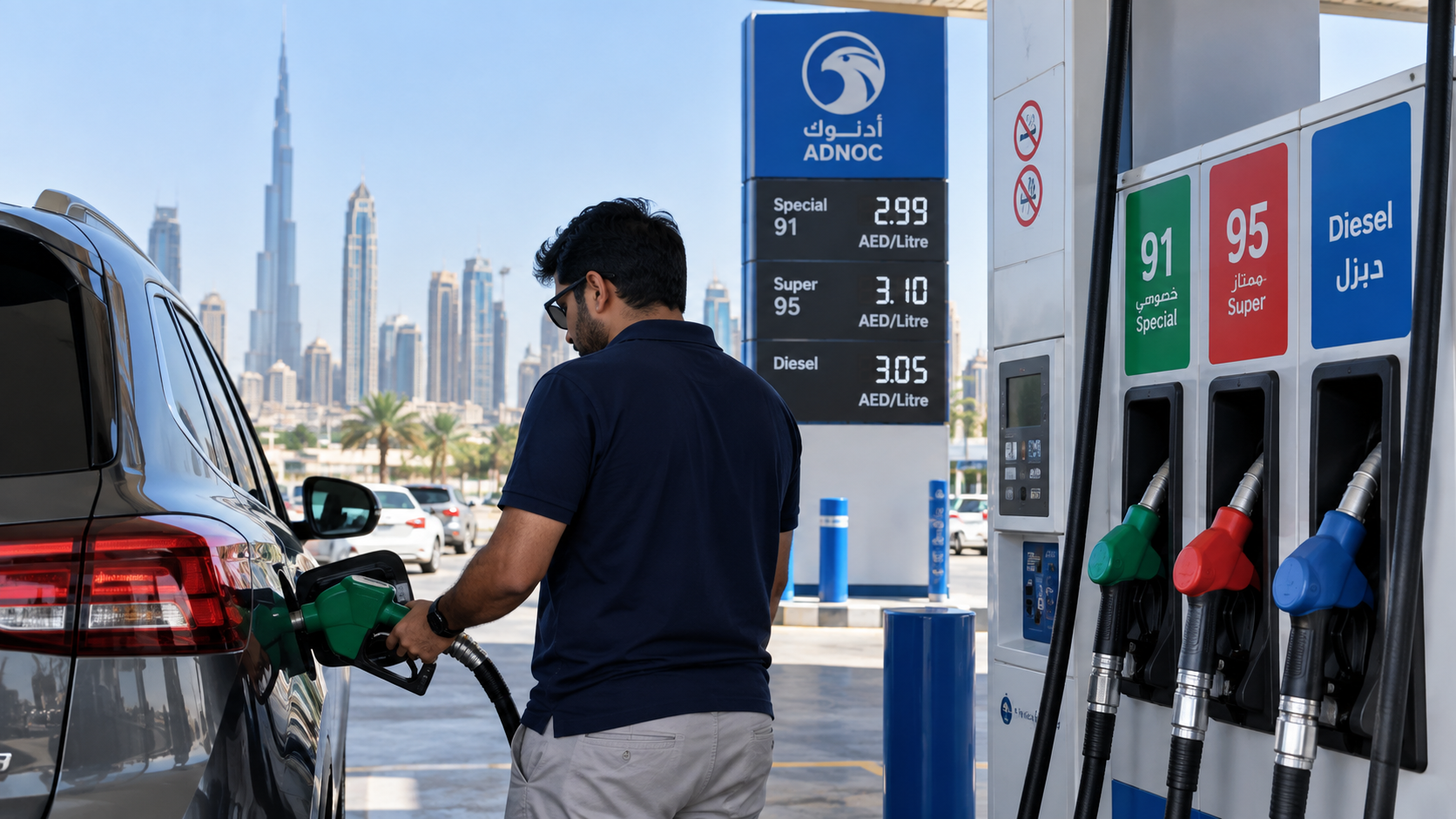
UAE Petrol Prices Hit Their Highest Levels This Year as Brent Holds Above $100
UAE pump prices rose again on 1 October, the third straight monthly increase, with Super 98 now at Dh4.40 a litre. Brent crude is above $100 and a G7 stock release has only partly offset the Middle East supply risk.
Filling up a car in the UAE now costs noticeably more than it did a month ago, and the oil market gives little sign of relief. Brent crude opened the week above $100 a barrel, leaving drivers and businesses to absorb the third consecutive monthly rise in pump prices.
October prices at a glance
New rates announced by the UAE Fuel Price Committee took effect on 1 October:
| Fuel | October price (per litre) | September price |
|---|---|---|
| Super 98 | Dh4.40 | Dh3.80 |
| Special 95 | Dh4.28 | Dh3.69 |
| E-Plus 91 | Dh4.21 | Dh3.61 |
| Diesel | Dh4.80 | Dh4.30 |
Every petrol grade now sits above Dh4 a litre, and diesel is close to Dh4.80. By simple arithmetic, the 60-fils increase on Super 98 adds about Dh30 to a 50-litre tank compared with September. Against levels before the conflict began, the gap is far larger. Gulf News estimates that motorists with a 50-to-60-litre tank are paying up to Dh125 more per fill-up than before the spike, and that retail prices have climbed by more than 60 per cent since fighting began in late February.
What is driving the market
Early on Monday in Tokyo, Brent was quoted at  110. West Texas Intermediate and natural gas edged lower, which created an unusual split between benchmarks.
The gap between Brent and WTI has widened to more than $11 a barrel. Analysts link that to the fact that Brent, a seaborne benchmark, carries more exposure to shipping disruption. When tankers are attacked, insurers raise premiums and voyages lengthen, and the cost of moving crude to buyers in Asia rises accordingly.
Tanker shortages have added to the pressure. Freight rates for very large crude carriers have surged to extraordinary levels, according to market reports, pushing up the delivered price of oil and squeezing refiners.
Behind all of this sits the standoff over the Strait of Hormuz. Iran's parliament speaker said on Monday that the strait would stay closed until the United States meets seven conditions, a stance that keeps a risk premium baked into prices even though flows are reportedly running at around 80 per cent of pre-war levels.
The G7 cushion
Governments have tried to ease the strain. The G7 agreed to release 100 million barrels of oil and fuel from emergency reserves, and the announcement helped take about $5 off prices. The relief has been limited, however. October's UAE rates were set using the earlier price spike, so drivers have not yet seen the benefit at the pump.
Whether November brings relief depends on what happens in the next few weeks. If tanker attacks continue, or if the fighting in Yemen disrupts traffic near Bab Al Mandab, crude could climb again. If diplomacy produces a breakthrough, prices could fall quickly.
Knock-on effects for households
Fuel is rarely just a fuel story. Higher diesel costs feed into trucking and delivery charges, which in turn can nudge up the price of groceries and household goods. Ride-hailing fares and delivery fees have also risen. For families who commute long distances, particularly between Sharjah, Dubai and Abu Dhabi, the monthly fuel bill has become a much bigger line in the budget.
There are practical steps that can soften the blow. Car-pooling, combining errands and keeping tyres properly inflated can all reduce consumption. The new Etihad Rail passenger service between Abu Dhabi and Dubai, which launched on 30 September with fares from Dh39, gives some commuters another option on that corridor.
What to expect
The next fuel price announcement is due at the end of October, and the committee has been clear that it follows global averages. Until the picture in the Gulf calms, motorists should plan for prices to remain elevated.
For businesses, the message is similar. Those with large fleets or heavy logistics costs may want to review contracts and fuel surcharges now rather than wait for the next announcement.
The UAE is not short of supply. But as long as the world's most important oil route remains a diplomatic bargaining chip, the price of every litre will carry a premium for risk.
Leave a comment
Your email address will not be published. Required fields are marked *