
Sheikh Khaled Meets Modi at BRICS Summit as UAE Deepens India Ties Across AI, Defence and Energy
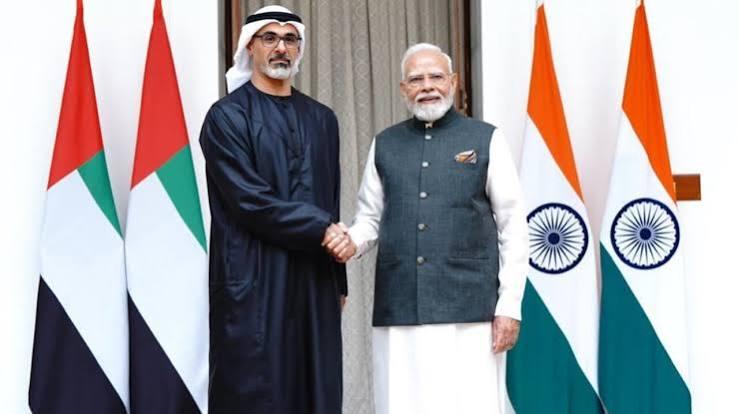
Abu Dhabi's Crown Prince Sheikh Khaled bin Mohamed bin Zayed Al Nahyan held bilateral talks with Indian Prime Minister Narendra Modi on the sidelines of the 18th BRICS Summit in New Delhi. The two leaders agreed to deepen cooperation across defence, artificial intelligence, space and energy, even as the summit grappled with divisions over the ongoing Middle East conflict.
Abu Dhabi's Crown Prince, Sheikh Khaled bin Mohamed bin Zayed Al Nahyan, sat down with Indian Prime Minister Narendra Modi on Saturday in New Delhi, using the sidelines of the 18th BRICS Summit to push forward one of the Gulf's most consequential partnerships in Asia.
The meeting, held at the historic Hyderabad House, came as Sheikh Khaled led the UAE delegation through a packed two-day summit schedule that has drawn leaders from all eleven BRICS member states, including China's Xi Jinping, Russia's representatives, and Iran's President Masoud Pezeshkian. For Abu Dhabi, though, the real substance of the day was bilateral: a wide-ranging conversation with Modi that touched on nearly every pillar of the modern UAE-India relationship.
A partnership built for the next decade
According to details shared after the talks, the two leaders discussed cooperation spanning defence manufacturing, artificial intelligence, space exploration, critical minerals, energy security, food security and cross-border connectivity. It is a list that reflects how far the relationship has evolved beyond its historical foundations in trade and remittances, moving instead toward the technologies and resources expected to define global competitiveness over the next twenty years.
Modi later described the relationship as one that has been transformed in recent years, signalling an intent from New Delhi to keep raising the ambition of joint projects rather than simply maintaining existing ones. For a country like India, which imports the bulk of its energy needs and is racing to build out its AI and semiconductor capabilities, the UAE has become both a financial partner and a testing ground for new industrial ventures. For the UAE, India represents a market of 1.4 billion people, a growing middle class, and a strategic hedge against volatility elsewhere in its trade portfolio.
A summit shadowed by regional conflict
The bilateral meeting unfolded against a far tenser backdrop inside the summit itself. Leaders have spent the two-day gathering trying to navigate sharp disagreements over how to characterise the ongoing conflict in the Middle East, with reports suggesting real friction between Iranian and Emirati positions on a proposed joint declaration. Despite those tensions, BRICS members — Iran and the UAE included — issued a joint call on Saturday urging maximum restraint across the region, a rare moment of unified messaging from a bloc that has struggled for consensus this year.
Chinese President Xi Jinping used his own remarks at the summit to describe the war in the Middle East as having inflicted serious losses on the wider region, adding that continued conflict serves no one's long-term interests. It is a sentiment that appeared to echo, at least in tone, the quieter diplomacy Sheikh Khaled has been engaged in throughout the summit, including a separate meeting with Iran's president on the sidelines — a signal that Abu Dhabi continues to see value in keeping channels open even amid deep regional strain.
Why this matters for the UAE
For everyday observers, a bilateral meeting between two leaders might read as diplomatic formality. But the substance discussed on Saturday has real economic weight. Cooperation in AI alone could translate into joint data infrastructure projects, talent exchanges and investment flows worth billions of dirhams over the coming years — echoing similar large-scale technology partnerships the UAE has recently struck with other major economies. Defence cooperation, meanwhile, touches on decades-old ties between the Indian and Emirati militaries, an area both governments have signalled they want to modernise.
Space and critical minerals cooperation also point to longer-term ambitions: India's growing space programme has drawn interest from Gulf sovereign investors, while critical minerals — used in everything from batteries to defence hardware — have become a strategic priority for governments seeking to reduce dependence on any single supplier.
What comes next
No formal agreements were announced immediately following the meeting, and further details are expected to emerge as the BRICS Summit concludes on Sunday. Analysts will be watching closely for whether the broader summit manages to produce a unified declaration despite the Iran-UAE tensions reported over the conflict language, and whether Saturday's bilateral warmth between Abu Dhabi and New Delhi translates into concrete announcements on AI or defence contracts in the weeks ahead.
For now, the takeaway from New Delhi is one of continuity: two governments that have steadily built one of the most active strategic partnerships in the Global South, choosing to deepen it even as the region around them remains under considerable strain.

Leave a comment
Your email address will not be published. Required fields are marked *