
UAE Petrol Prices Jump About 16% for October as Oil Markets Stay Elevated
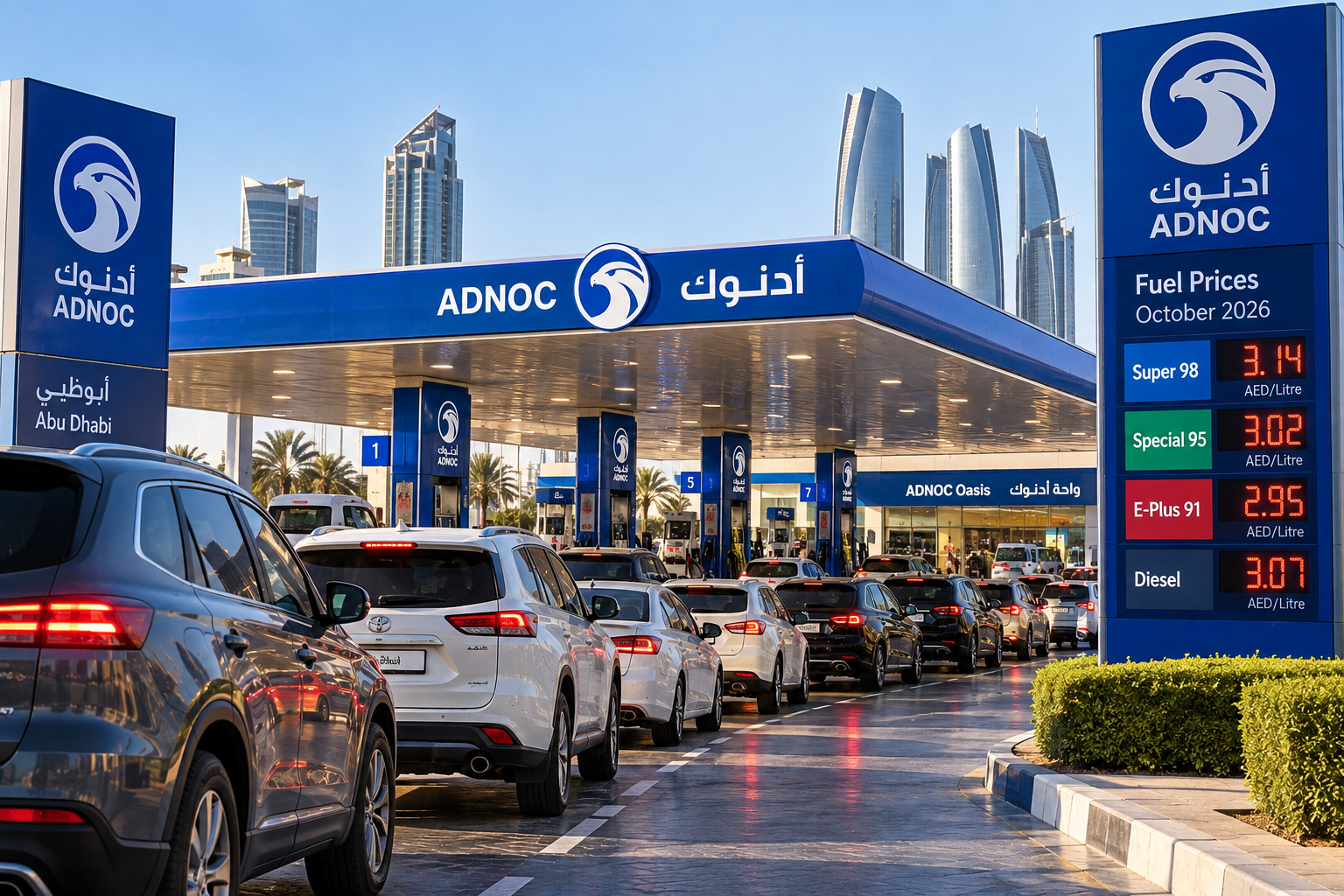
UAE fuel prices rise for a third straight month in October, with Super 98 up 15.7% to Dh4.40 and diesel up 11.6% to Dh4.80. Global crude remains elevated amid uncertainty over US–Iran talks and disruption around the Strait of Hormuz.
Drivers across the UAE will pay noticeably more at the pump in October, with petrol prices rising for a third consecutive month as global oil markets stay elevated.
The increases are sharp. Super 98 goes up by 15.7 per cent, Special 95 by almost 16 per cent, E-Plus 91 by 16.6 per cent and diesel by 11.6 per cent.
The new prices
Here is how the new prices compare with September, per litre:
| Fuel | September | October |
|---|---|---|
| Super 98 | Dh3.80 | Dh4.40 |
| Special 95 | Dh3.69 | Dh4.28 |
| E-Plus 91 | Dh3.61 | Dh4.21 |
| Diesel | Dh4.30 | Dh4.80 |
To put that in household terms, filling a 50-litre tank with Super 98 now costs about Dh220, compared with roughly Dh190 last month. For Special 95, the same tank moves from about Dh184 to Dh214. These are illustrative figures rather than official ones, but they show how quickly a monthly adjustment reaches family budgets.
Diesel deserves a closer look. It remains the most expensive fuel at the pump, yet its rise is the gentlest of the four. Diesel adds 50 fils a litre, while the three petrol grades each climb by roughly 60 fils. In percentage terms the gap is wider, at 11.6 per cent against 15.7 to 16.6 per cent, simply because diesel starts from a higher base. Even so, for hauliers, bus operators and construction firms that run on it, a Dh4.80 litre is a cost that reaches everything from freight rates to project budgets.
Why prices keep climbing
UAE pump prices have followed global oil markets since fuel deregulation in 2015. They do not always move in perfect step with benchmarks, but the direction of travel is clear when crude spikes.
This September, it spiked. Brent crude came close to  105 after the United States and Iran resumed attacks on each other, with the Strait of Hormuz remaining a flashpoint. Yemen's Houthi rebels also stepped up strikes on Saudi Arabian facilities in the Red Sea.
Over the month, Brent has gained about 9.5 per cent, while WTI is up by a fraction. The longer view is starker. UAE petrol prices last fell in July, when crude sat near pre-war levels during a period of calm between Washington and Tehran. Since the start of that month, Brent has risen by almost 45 per cent and WTI by nearly a third.
A tangled shipping picture
The disruption extends beyond headline prices. Oil moving through the Strait of Hormuz reached its highest volume this month since the Iran war began, as Saudi Arabia pushed more crude through the contested waterway after Houthi attacks restricted its Red Sea route.
Preliminary Kpler data shows Saudi shipments through Hormuz rose to 2.58 million barrels a day in September, up from about one million in August, giving the kingdom 43 per cent of the strait's oil traffic. Meanwhile, flows through the Bab Al Mandeb strait more than halved, falling to 2.56 million barrels a day from 5.45 million. The extra volume through Hormuz was not enough to offset the wider fall in regional oil traffic.
Diplomacy holds the key
Oil has eased in recent days on hopes that Washington and Tehran can reach a wider agreement, helped by mediated contacts at the UN General Assembly in New York. So far this week both Brent and WTI have slipped.
But the talks have reached a stalemate, and efforts to reopen the Strait of Hormuz continue to stall. Sources say the two sides are quietly seeking common ground as a prelude to full negotiations to end seven months of conflict, though no clear breakthrough has emerged.
What this means for residents
For motorists, the immediate effect is a higher bill. For businesses, particularly logistics firms that run on diesel, the rise adds to operating costs at a time when Dubai is also tightening rules on heavy vehicles and pushing more commuters toward rail.
Prices are reset monthly, so a genuine diplomatic breakthrough could feed through to lower pump prices later, as it did in July. Until then, drivers who can consolidate trips, keep tyres properly inflated and consider public transport, including the new Etihad Rail service, may soften the impact.
The next monthly announcement will show whether October's spike proves a peak or the start of a longer climb.

Leave a comment
Your email address will not be published. Required fields are marked *