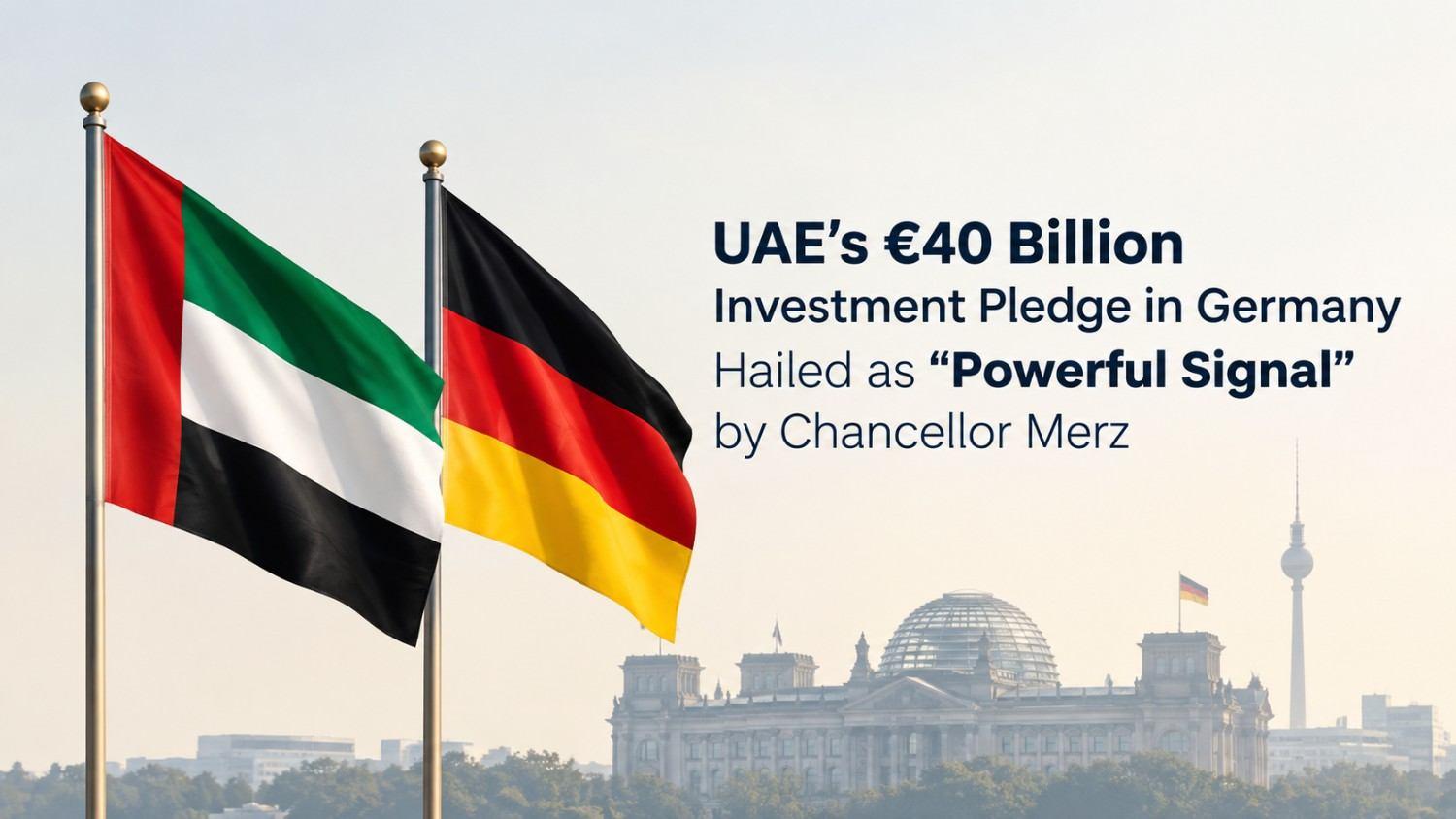
UAE's €40 Billion Investment Pledge in Germany Hailed as "Powerful Signal" by Chancellor Merz
German Chancellor Friedrich Merz has welcomed the UAE's newly announced €40 billion investment package, unveiled during President Sheikh Mohamed bin Zayed's first state visit to Germany. The funds will target artificial intelligence, digital infrastructure and energy, building on more than €34 billion already invested by the UAE in the country.
German Chancellor Friedrich Merz has publicly praised the scale of a newly announced UAE investment package in Germany, calling it a powerful signal of confidence in the country's economy at a moment when Europe's largest economy is looking for exactly that kind of vote of confidence.
The €40 billion pledge, worth roughly $46.5 billion, was unveiled this week during President Sheikh Mohamed bin Zayed Al Nahyan's state visit to Berlin — his first as UAE president and the first-ever state visit to Germany by a sitting Emirati head of state. The three-day trip, which ran from September 9 to 11 at the invitation of German President Frank-Walter Steinmeier, culminated in a signing ceremony and a joint declaration outlining the scope of the new economic partnership.
Where the money is going
According to details released by both governments, the investment will be spread across advanced industry, artificial intelligence, digital infrastructure and energy. A notable component involves new data centres with a combined capacity of roughly one gigawatt — infrastructure that would place the UAE among the more significant foreign investors in Germany's push to modernise its digital backbone. Of the total package, €10 billion has been earmarked specifically for the southern state of Bavaria, a region long associated with Germany's automotive and advanced manufacturing base.
Officials from both sides framed the announcement as building on an already substantial relationship rather than starting one from scratch. The UAE has reportedly invested close to €34 billion in Germany prior to this new package, meaning the combined total, if fully delivered, would exceed €74 billion — a figure that underscores just how central Germany has become to Abu Dhabi's European investment strategy.
A statement from Merz's office
In a statement released through his office, Chancellor Merz said he was impressed by the UAE's willingness to invest in Germany, describing the move as a signal that will help bring jobs, competitiveness and innovation capacity to the country. He also credited Sheikh Mohamed's personal understanding of the German business environment, noting the president's evident familiarity with the country as a place to do business.
The announcement also included the establishment of a formal UAE-Germany Investment Council, created through a Joint Declaration of Intent, intended to serve as an ongoing platform linking public and private sector actors from both countries. Alongside it, the two governments launched what they are calling a Strategic Dialogue, built around a twelve-point cooperation roadmap covering trade, technology and security matters.
The wider context
The timing of the visit is notable. It comes as regional tensions tied to the broader conflict between the United States, Israel and Iran continue to weigh on economies across the Middle East, prompting governments in the Gulf to look outward for diversification opportunities. Abu Dhabi has for years been one of Berlin's most significant defence customers, regularly ranking among the top purchasers of German military equipment, which adds a layer of strategic depth to a relationship that now stretches well beyond arms sales and into next-generation technology.
One detail likely to interest UAE frequent flyers: aviation access has also been flagged as a priority area in ongoing discussions, with Emirates' ambitions to expand routes into Berlin Brandenburg Airport reportedly under renewed discussion, an issue that has been complicated for years by older regulatory restrictions dating back to 1994.
What it means going forward
Neither government has yet detailed which specific companies will build or operate the new data centre capacity, nor precisely when construction is expected to begin — a gap that independent analysts have flagged as worth monitoring in the months ahead. Still, the scale of the pledge, and the public enthusiasm from Germany's chancellor, suggest this is intended as a long-term strategic bet rather than a one-off announcement.
For the UAE, the deal reinforces a pattern seen across several major economies this year: large, headline-grabbing capital commitments paired with new institutional structures designed to keep the relationship active well beyond the signing ceremony. Whether the promised jobs and technological gains materialise at the scale both sides are hoping for will likely become clearer as the Investment Council begins its work in the coming months.