
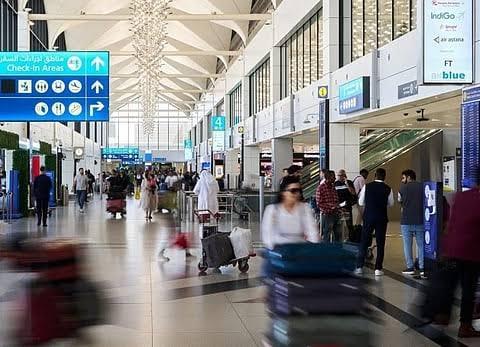
UAE Flights Run With Delays as Foreign Airlines Stagger Their Return
Air travel from Dubai and Abu Dhabi is operating but uneven, with delays, some regional cancellations and many international carriers still suspended. Dubai Airports says airline capacity has recovered to about 84 per cent of earlier levels.
Anyone flying out of the UAE on Monday should check their booking before leaving home. UAE flight status is mixed: services are running, but delays and cancellations continue as airlines adjust to regional tensions.
What is happening at the airports
Some early-morning delays were reported at Abu Dhabi and Dubai, while airlines continue to adjust schedules amid heightened regional tensions. Airport websites showed little to no delays at both Dubai International and Zayed International, though flight trackers showed some early departures affected. Both airports advise passengers to confirm details with their airlines.
Who is flying and who is not
Etihad has largely kept services to Bahrain, Kuwait, Riyadh, Al Qassim and Medina running, although flights to Dammam and Jeddah were delayed. Emirates has services to Bahrain and Kuwait scheduled. Flydubai and Air Arabia recorded a few cancellations, including Dubai-Bahrain and Dubai-Yanbu for flydubai and several Sharjah-Kuwait and Sharjah-Bahrain services for Air Arabia. Gulf News notes that some cancellations may stem from operational or technical issues rather than the wider situation.
A recovery that is real but incomplete
The numbers show a sector rebuilding rather than back to normal. Dubai Airports CEO Paul Griffiths has said airline capacity at DXB has recovered to about 84 per cent of previous levels, with passenger volumes at 78 per cent. Emirates operated at around 93 per cent of pre-disruption capacity in July and August, and flydubai expects to restore its full network, potentially exceeding it, by the end of 2026.
Among foreign carriers the picture is uneven. Turkish Airlines has resumed Dubai and Abu Dhabi services. Qatar Airways has recovered to more than 160 destinations, around 85 per cent of its pre-war network. Air India and Air India Express have restored full GCC networks, with roughly 780 weekly flights between India and the region.
Others are waiting. British Airways plans to resume Dubai flights on November 4, Wizz Air is preparing to return in late October, and Air Astana will restart Kazakhstan-Dubai flights in early October. Lufthansa, SWISS, KLM, Singapore Airlines, ITA Airways, Finnair and AirBaltic have suspended Dubai services through October 24. Air France has extended its Dubai suspension through October 13, Cathay Pacific through November 30, and Air Canada until mid-January 2027. Virgin Atlantic's London-Dubai route is suspended for the foreseeable future.
The security backdrop
The disruption traces back to the conflict involving Iran, now nearly seven months old. Iran's military says it believes the US is preparing to resume strikes and has vowed to retaliate. Meanwhile, the US has warned that fighting between Saudi Arabia and Iran-backed Houthi forces could escalate quickly after a missile targeted Riyadh. Diplomacy is also moving, with leaders gathering in New York this week, but airlines are planning around uncertainty.
What governments are advising
Travel advisories have eased in some places but not others. The UK has lifted its broad warning against all but essential travel to hubs including the UAE, Kuwait and Qatar, while cautioning that conditions remain unpredictable. The US rates the UAE at Level 3, "Reconsider Travel," and has ordered non-emergency government staff and their families to leave. Australia has lowered its UAE advice from Level 4 to Level 3. Canada urges a high degree of caution and suggests keeping documents current and supplies on hand in case of shelter-in-place situations.
Practical advice before you fly
Gulf News advises checking your flight immediately before leaving, arriving at least three hours ahead, completing online check-in where possible, and keeping contact details updated with your airline. Flydubai asks passengers departing Dubai to allow at least four hours.
If your flight is with an airline that has suspended UAE services, check whether you are entitled to a rebooking or refund, and keep records of communication with the carrier. Because schedules are being revised at short notice, a booking made months ago may no longer match what is operating.
For residents and business travellers, the picture is one of gradual normalisation with real limits. Regional routes are the most sensitive, long-haul capacity is coming back in stages, and carriers such as British Airways and Wizz Air have set dates for their returns, giving travellers some clarity for the autumn.


Leave a comment
Your email address will not be published. Required fields are marked *